
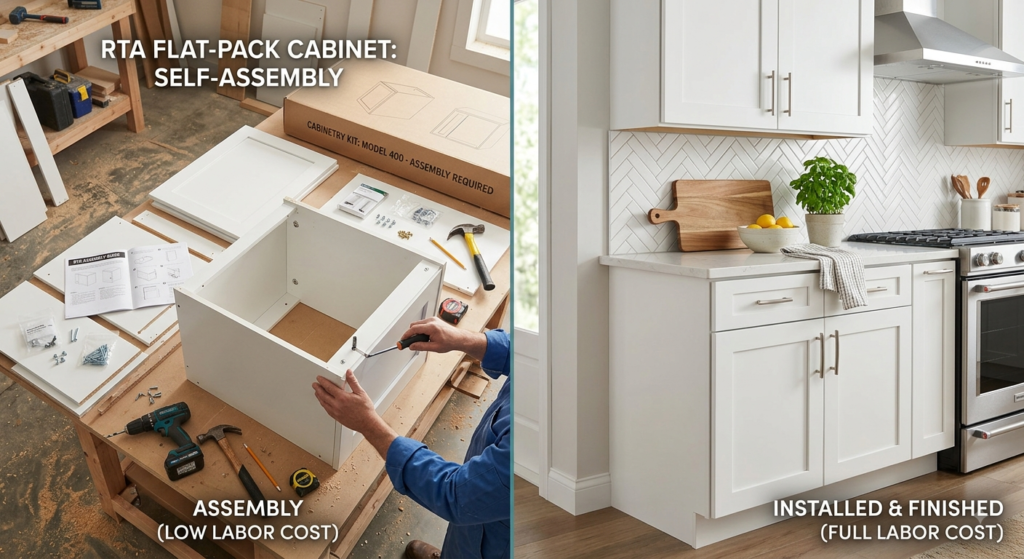
“Affordable” and “cheap” get used interchangeably for kitchen cabinets, but they’re not the same purchase. Cheap cabinets cut cost by swapping materials particleboard boxes, stapled joints, no soft-close hardware. Affordable cabinets cut cost by changing how the cabinet gets made and delivered, while keeping the underlying material intact. Knowing which levers you’re actually pulling is the difference between a kitchen that looks fine at installation and one that still closes properly in five years.
What Actually Drives Cabinet Cost
Four variables set the price of a kitchen cabinet order: the linear footage you need to cover, the base material (particleboard, MDF, plywood, or solid wood), the production method (mass-produced stock, flat-pack RTA, semi-custom, or fully custom), and labor assembly plus installation. Materials and production method are where most of the controllable savings live; labor is where costs quietly balloon if you’re not paying attention.
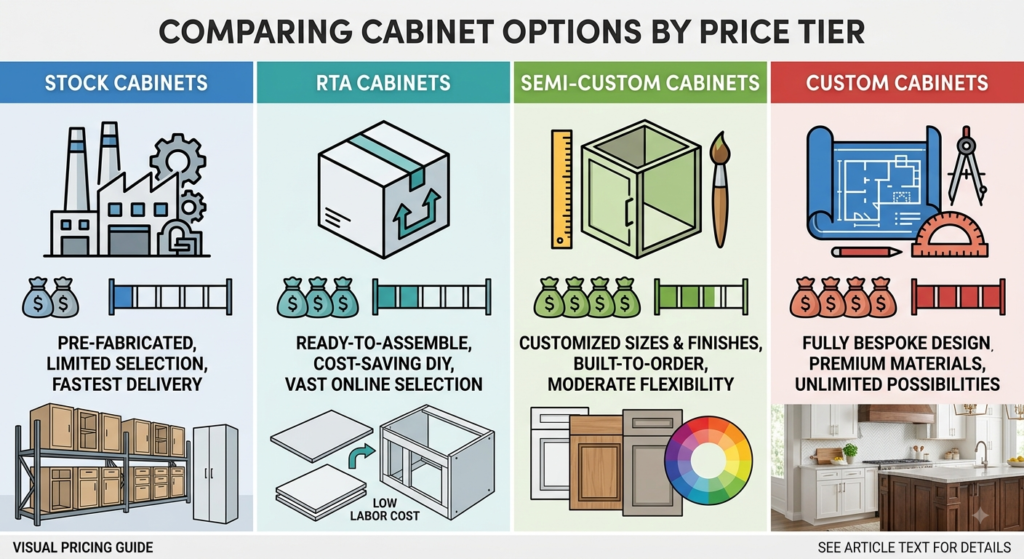
Comparing Cabinet Options by Price Tier
| Type | Typical Price Position | Sizing Flexibility | What You’re Trading Off |
|---|---|---|---|
| Stock cabinets | Lowest | Fixed standard sizes only | Limited layout options, often particleboard |
| RTA (ready-to-assemble) | Low-to-mid | Standard sizes, wide style range | You handle assembly labor yourself |
| Semi-custom | Mid | Standard boxes, custom finishes/sizing add-ons | Longer lead time than stock or RTA |
| Fully custom | Highest | Unlimited | Highest labor and material cost |
Stock cabinets keep costs down through volume manufacturing, which usually means a narrower range of finishes and a higher chance the boxes are particleboard rather than plywood or solid wood. RTA cabinets save money on a different lever entirely shipping flat and skipping factory assembly labor which means an RTA line can be built from the exact same solid-wood material as a fully assembled one. That’s the detail worth knowing before assuming “flat-pack” automatically means lower quality: it doesn’t have to.
The Material Trap
Most “budget” cabinet lines hit their price point by using particleboard or thin MDF for the cabinet box, then wrapping it in a wood-look laminate. That construction holds up fine in a low-humidity, low-traffic setting, but it’s genuinely risky in a Montreal kitchen, where seasonal humidity swings can cause particleboard to swell at the seams within a few years. If durability matters as much as the upfront number, the material question deserves more weight than the production-method question. Our guide to kitchen cabinet materials breaks down solid wood, plywood, MDF, and particleboard side by side, and our hardwood species comparison covers which woods hold up best if you’re staying solid wood on a tighter budget.
Money-Saving Levers That Don’t Touch Material Quality
Standard sizing over custom dimensions. Every cabinet run built to a non-standard width or height requires custom shop time. Designing your layout around standard cabinet widths even if it means an extra filler panel avoids that labor premium entirely.
Self-assembly. RTA cabinets shift the assembly labor from the factory floor to your kitchen, which is the single biggest cost lever available without touching materials. For a full breakdown of how that works, see our guide to RTA kitchen cabinets.
Refacing instead of replacing. If the existing cabinet boxes are structurally sound, refacing new doors, drawer fronts, and veneer over the existing frame can deliver most of the visual change of a full replacement at a fraction of the material and labor cost.
Financing the difference. Where the math doesn’t quite work for solid wood upfront, financing (MontRiver offers Flexiti) can close the gap between a particleboard stock cabinet and a solid-wood RTA order without changing what actually goes into your kitchen.
What “Too Cheap” Usually Means
A few warning signs separate genuinely affordable cabinets from cabinets that will cost more in five years than they saved today: drawer boxes stapled rather than doweled or dovetailed, drawer glides rated for light loads without soft-close damping, particleboard with no moisture sealant on cut edges, and door hinges that aren’t adjustable. None of these show up in a showroom photo they show up after a year of daily use.
Choosing the Right Affordable Option
If your priority is the lowest possible number and the kitchen sees light use, stock cabinets in MDF or laminate are a reasonable, honest choice. If you want solid wood without the fully-assembled price premium, RTA is the more direct lever same material, lower labor cost. If your existing boxes are still sound, refacing beats replacement outright. And if the gap is purely cash-flow rather than cost, financing lets you avoid the material trade-off altogether.
FAQs
Q1: What is the most affordable type of kitchen cabinet?
Stock cabinets in standard sizes are typically the lowest-cost option, since mass production keeps material and labor costs down. RTA (ready-to-assemble) cabinets are the most affordable way to get solid wood, since you handle the assembly labor yourself.
Q2: Are affordable kitchen cabinets lower quality?
Not necessarily. “Affordable” can come from production method like flat-pack shipping or self-assembly without changing the base material. “Cheap” cabinets, by contrast, usually cut cost by using particleboard or thin MDF, which is where quality actually suffers.
Q3: Is it cheaper to reface or replace kitchen cabinets?
Refacing is generally cheaper than full replacement when the existing cabinet boxes are structurally sound, since it reuses the frame and only replaces doors, drawer fronts, and veneer.
Q4: Do RTA cabinets hold up as well as pre-assembled ones?
When built from the same base material, RTA cabinets perform the same as pre-assembled cabinets long-term. The savings come from skipped factory assembly labor, not from a change in the wood or hardware itself.
